



By: Isabel Balagat Mar 25/2026


By now, you’ve probably seen AI Overviews at the top of your Google searches, pulling information from the SERPs to present you with answers to your queries. Now, AI Overviews has expanded to include ads in its results, pulling typically from Shopping, Performance Max, and other AI-powered campaigns. This all contributes to the “zero-click” trend that has been seen by SEOs since the introduction of AI Overviews. So, how can we adjust to these changes and ensure our ads are successful? Keep reading to learn more.
Before diving into strategy, it helps to understand where ads now appear in Google’s AI-powered search ecosystem, because not all placements are equal.
Ads in AI Overviews (AIO) appear near the AI-generated summary that sits at the top of a Google search results page. They can show up alongside the cited sources panel on the right, or directly below the AI overview answer itself.

Google is also testing ads in AI Mode — its standalone conversational search experience, similar to ChatGPT, accessible via a dedicated tab. Unlike AI Overviews, AI Mode is designed for deeper, multi-step queries. Ads in AI Mode may appear below and be integrated into responses when relevant. The feature is currently being tested in the US. This placement is still early-stage, and details will continue to evolve.

Standard ads still appear above and below the search results page, just as they always have. For the purposes of this guide, we’ll focus on the ads in Google AI Overviews placement.
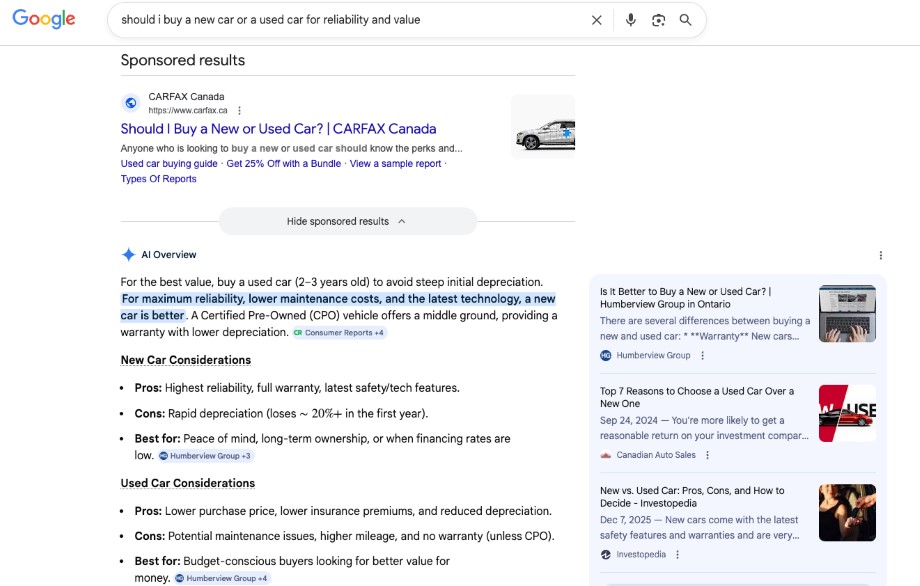
Here’s a current summary of how this placement works:

The short answer: lean into Google’s AI-powered campaign tools.
Ads appearing in AI Overviews are eligible only for Performance Max, AI Max for Search, and broad match campaigns. If your campaigns rely solely on exact or phrase match keywords, they won’t qualify for this inventory.
Why does this matter? AI Overviews are triggered by complex, exploratory, and conversational queries – the kind that rigid keyword lists weren’t built to capture. To appear within an AI Overview, ads must be relevant not only to the user’s query but also to the themes and information surfaced in the AI-generated response itself.
AI-powered campaign types (e.g., Performance Max, Shopping, and Search campaigns using broad match or AI Max) are built to match that dynamic. They can identify relevant long-tail and contextual queries that purely keyword-based campaigns miss entirely.
While there’s genuine excitement around these new placements, showing up in AI Overviews won’t save a fundamentally weak campaign.
The businesses that will win in this new landscape are those who get the basics right first: ads tailored to your audience, creative assets that are genuinely useful and trustworthy, accurate conversion tracking, and high-quality first-party data feeding your campaigns. Ads don’t appear in AI Overviews because they’re “AI-optimized.” They appear because Google already trusts them.
Think of AI placements as a multiplier. Strong fundamentals, multiplied by AI-powered reach, equal better visibility across search, which includes these new conversational experiences. On the other hand, ads that lack fundamentals, if multiplied by AI, tend to amplify the problems.
The advice that matters most right now: optimize your ads to answer the “How,” “What,” and “Why” questions your customers are asking, because those are exactly the queries that trigger AI Overviews.
If you need help improving your visibility across Google’s AI Overviews and today’s rapidly evolving search landscape, contact our team – we’d love to help!
